Technologies - Battery Management Systems & Lithium Batteries
Safe, efficient and reliable energy management
Lithium-based battery technologies have revolutionised energy storage, offering high energy density, lightweight profiles and long operational lifetimes. However, to unlock their full potential and guarantee maximum safety, lithium batteries require sophisticated electronic supervision.
Acies designs and develops custom Battery Management Systems (BMS) and advanced energy storage architectures for industrial, medical, scientific and aerospace applications. Our engineering team bridges the gap between electrochemistry and electronic hardware, delivering robust systems where safety and long-term reliability are non-negotiable requirements.
Advanced BMS hardware architecture
A reliable BMS must operate flawlessly under harsh environmental conditions, managing high currents and voltages while capturing micro-volt variations across cells.

Our custom BMS designs focus on multi-layered safety and extreme measurement accuracy, incorporating:
- High-precision cell voltage monitoring (sub-millivolt accuracy);
- Multi-channel redundant temperature sensing;
- Isolated current sensing via high-stability shunts or Hall-effect sensors;
- Active and passive cell balancing networks to maximise pack capacity;
- Hardware-based over-voltage, under-voltage and over-current protection;
- Galvanic isolation for high-voltage battery stacks;
- Ultra-low power consumption states to prevent self-discharge during storage.
State-of-Charge (SoC) and State-of-Health (SoH) estimation
Knowing the exact state of a battery pack is critical for system autonomy and predictive maintenance. Acies integrates proprietary mixed-signal algorithms and real-time processing directly into microcontrollers or dedicated embedded platforms.
We implement advanced tracking methodologies, including:
- Coulomb counting with automatic drift correction;
- Open-circuit voltage (OCV) tracking and thermal compensation;
- Internal resistance estimation for precise SoH evaluation;
- Cell ageing modeling and remaining useful life (RUL) prediction;
- Black-box fault logging for diagnostic analysis.
Industrial, medical and harsh-environment applications
Different sectors demand specific compliance, safety standards and form factors. We do not offer rigid off-the-shelf products; instead, we tailor the battery electronics to the specific architecture of your system.
Our expertise in lithium battery management includes:
- Space & CubeSat subsystems: Radiation-tolerant components, thermal vacuum compatibility and redundant topologies;
- Medical devices: Compliance with strict safety standards, intrinsic safety barriers and fail-safe operation;
- Industrial automation & AGVs: High-power discharge handling, fast-charging profiles and ruggedized communication buses;
- Scientific instruments: Ultra-low electromagnetic interference (EMI) design to avoid disrupting sensitive sensor electronics.
Smart connectivity and system integration
Modern energy storage systems must communicate smoothly with the host application or central control units. Our BMS architectures integrate standard industrial and automotive communication protocols to ensure seamless data exchange.
Supported interfaces and digital architectures include:
- CAN bus (CANopen / J1939) and isolated CAN-FD networks;
- Modbus RTU/TCP, I2C, SPI and UART interfaces;
- Dual-core MCU architectures separating critical protection from communication tasks;
- Secure boot and encrypted firmware updates for critical infrastructure safety;
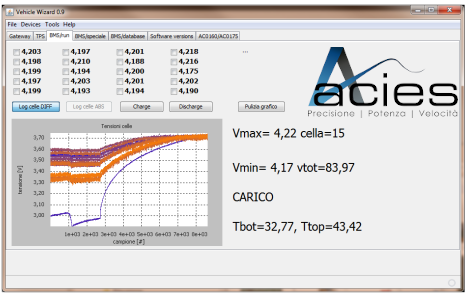
- Custom GUI development for lab testing and field diagnostics.

Safety validation and testing
Every BMS design undergoes extensive verification in our laboratory. We perform automated hardware-in-the-loop (HIL) simulations, thermal imaging under heavy loads and controlled stress-testing to guarantee that all hardware and software protection limits trigger exactly when required, shielding your system from thermal runaway or catastrophic failures.