Technologies - Advanced analogue electronics
Precision where physics meets engineering
Despite the rapid evolution of digital electronics, analogue circuitry remains the fundamental interface between the physical world and digital information. Every sensor, detector, actuator, battery system or scientific instrument relies on analogue electronics to acquire, condition and process real-world signals before they can be analysed or controlled.
For over twenty years, Acies has been designing advanced analogue and mixed-signal electronics for industrial, scientific, medical, aerospace and energy applications, delivering custom solutions where precision, reliability and long-term stability are critical requirements.
Our expertise spans from ultra-low-noise sensor front-ends to high-voltage power electronics, integrating analogue, digital and FPGA technologies into complete embedded systems.
Precision analogue front-end design
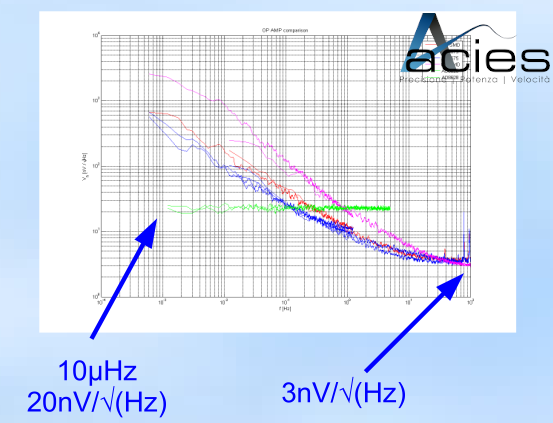
Advanced analogue is not only a matter of using the best available components, but above all knowing them deeply. We conduct regularly measurement campaign for analogue devices, in order to propose to our Customers the best possible options for their applications.
The performance of any measurement system depends on the quality of its analogue front-end.
Acies develops custom analogue circuits optimised for:
- ultra-low noise;
- high dynamic range;
- low offset and drift;
- excellent linearity;
- thermal stability;
- low power consumption;
- electromagnetic robustness.
- transimpedance amplifiers;
- instrumentation amplifiers;
- differential amplifiers;
- programmable gain amplifiers;
- active filters;
- precision voltage references;
- current sensing circuits;
- charge-sensitive preamplifiers;
- shaping amplifiers;
- anti-aliasing filters;
- analogue multiplexers;
- high-resolution ADC and DAC interfaces.
Sensor interface electronics
Every sensor technology presents unique electrical characteristics and noise sources.
Acies develops dedicated analogue interfaces for:
- photodiodes;
- Silicon Photomultipliers (SiPM);
- scintillation detectors;
- PMTs;
- temperature sensors;
- pressure sensors;
- strain gauges;
- Hall-effect sensors;
- electrochemical sensors;
- gas sensors;/li>
- battery monitoring systems;
- custom scientific detectors.

Along with analogue electronics, the subsequent signal processing chain is of paramount importance. Nowadays, signal processing is preferably digital. We have plenty of expertise in implementing these systems in FPGA, MCU and DSP and desktop PCs.
Scientific instrumentation
Scientific applications often push analogue electronics to their physical limits.
Acies has developed analogue electronics for:
- radiation detectors;
- nuclear spectroscopy;
- particle detection;
- photon counting;
- laboratory instrumentation;
- custom data acquisition systems;
- detector biasing networks;
- pulse shaping electronics;
- precision timing circuits.
Battery and power analogue systems
Advanced power electronics increasingly rely on sophisticated analogue control and monitoring techniques.
Acies designs analogue subsystems for:
- Battery Management Systems;
- cell balancing;
- battery monitoring;
- precision current measurement;
- isolated voltage sensing;
- power converters;
- LED drivers;
- ignition circuits;
- discharge lamp drivers;
- high-voltage power supplies;
- protection electronics.
Mixed-signal system design
Modern electronic systems combine analogue precision with digital flexibility.
Acies develops complete mixed-signal architectures integrating:
- analogue front-ends;
- high-speed ADCs;
- precision DACs;
- FPGA processing;
- STM32 and RISC-V microcontrollers;
- DSP algorithms;
- real-time digital filtering;
- closed-loop control systems.

This is what we want to deliver to our Customers: improvements. Performance, reliability, environmental conditions. Pave the way for new applications.
Space and harsh-environment electronics
Analogue electronics for aerospace and harsh environments requires exceptional reliability.
Acies supports projects involving:
- CubeSat subsystems;
- radiation-tolerant electronics;
- space instrumentation;
- environmental monitoring;
- industrial automation;
- long-life embedded systems.
Signal integrity and EMC
High-performance analogue electronics cannot rely solely on schematic design.
Acies applies advanced methodologies for:
- signal integrity analysis;
- EMC-oriented PCB layout;
- low-noise grounding;
- controlled impedance routing;
- analogue and digital partitioning;
- thermal management;
- power distribution optimisation;
- electromagnetic compatibility.
Simulation and verification
Reliable analogue electronics requires extensive modelling and validation.
Our development workflow includes:
- system-level modelling;
- SPICE simulations;
- Monte Carlo analysis;
- worst-case analysis;
- thermal simulations;
- tolerance analysis;
- prototype validation;
- automated testing;
- environmental qualification;
- production support.
Typical application areas
Our advanced analogue technologies support projects in:
- scientific instrumentation;
- nuclear physics;
- medical devices;
- industrial automation;
- renewable energy;
- battery technologies;
- aerospace;
- environmental monitoring;
- optical systems;
- embedded sensing platforms.
Typical performance targets
Depending on the application requirements, our analogue designs can achieve:
- microvolt-level offset;
- ppm-level stability;
- effective resolutions beyond 16 bits;
- picoampere current measurements;
- sub-microamp standby currents;
- bandwidths from DC to RF;
- high common-mode rejection;
- low total harmonic distortion;
- long-term thermal stability.
From concept to production
Acies provides complete engineering support throughout the entire product lifecycle:
- feasibility studies;
- architecture definition;
- circuit design;
- PCB layout;
- firmware integration;
- FPGA development;
- prototype manufacturing;
- laboratory testing;
- certification support;
- production transfer.
Why Acies?
Advanced analogue electronics is not simply about designing circuits. It is about understanding the underlying physics of the application and transforming physical phenomena into accurate, reliable and actionable information.
Whether the challenge involves detecting single photons, monitoring high-energy battery systems, controlling high-power devices or developing instrumentation for space and scientific missions, Acies combines analogue expertise with modern mixed-signal technologies to deliver custom electronic solutions tailored to the most demanding applications.
Related Technologies
This technology naturally integrates with several other Acies competencies:
- Battery Management Systems;
- Scientific Instrumentation;
- Nuclear Detection Systems;
- Data Acquisition Electronics;
- CubeSat Technologies;
- Embedded Systems;
- FPGA Development;
- LED and Optical Driver Electronics;